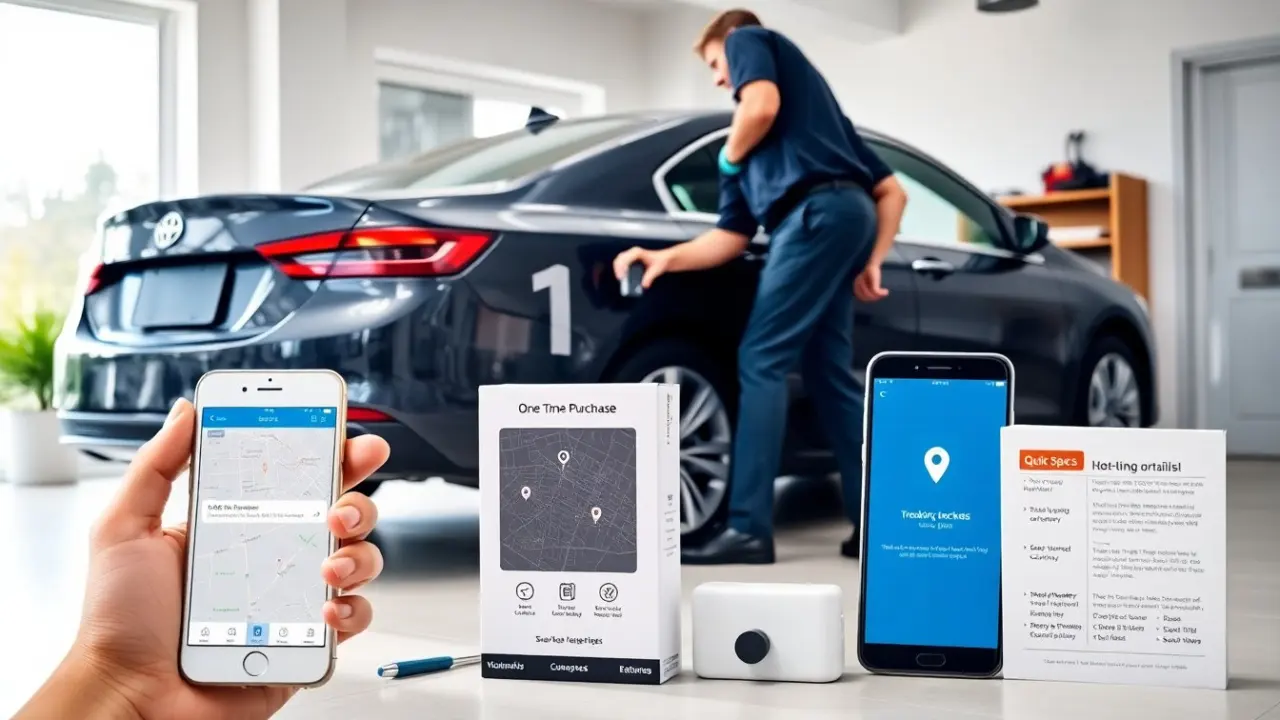
Many people search for the best gps tracker for car without subscription to avoid monthly fees. This guide lists reliable options that use one-time purchases or free tracking apps. It explains the main tracker types, outlines practical trade-offs, and gives concrete steps for installation, maintenance, and troubleshooting. The goal is to help readers choose a tracker that fits budget and needs without surprises—whether you need occasional location checks, covert long-term logging, or continuous location updates without a recurring plan.
Key Takeaways
- The best GPS tracker for car without subscription balances accuracy, battery life, and the required level of access (live updates vs. local logs).
- Tracker types: hardwired and OBD-II provide continuous power; battery-powered loggers are best for covert or intermittent tracking; Bluetooth trackers are lowest cost but phone-dependent.
- Look for clear app features (live location, history export, configurable ping intervals) and security (app authentication, encrypted storage) even when avoiding monthly fees.
- Installation choice affects concealment, theft risk, and maintenance: magnetic mounts and adhesive plugs are easy but less permanent; hardwiring is discreet and reliable but requires basic wiring skills or professional installation.
- Carefully check local laws and consent requirements before installing any tracker on a vehicle you do not own.
- Buy from sellers with firm return policies and firmware update support to keep a subscription-free device usable over time.
What To Look For In A Subscription-Free Car GPS Tracker
Battery life matters. A tracker must last days to months depending on use; check manufacturer-listed runtime for specific ping intervals rather than a single “up to” figure. Typical real-world battery life varies greatly with reporting frequency: updating every 30 seconds uses far more power than a single report every 10–15 minutes. Many consumer trackers publish multiple run-time scenarios—compare those.
Accuracy matters. For urban recovery or parking-location tasks, sub-10 meter accuracy is ideal; for general monitoring, 10–30 meters is often acceptable. Look for devices that combine GPS with GLONASS or other satellite systems and that list typical urban and open-sky performance rather than a single precision number.
Data access matters. There are three common models for subscription-free tracking:
- Local loggers: store tracks to internal memory (or microSD) and require periodic retrieval via USB or Bluetooth. They avoid any network fees but do not provide live tracking unless you physically access the device or sync it to a phone.
- Bluetooth+phone: the tracker provides location or beaconing while a paired smartphone supplies network connectivity. This avoids a SIM card and ongoing fees but requires the phone to be present, charged, and connected.
- One-time cellular or SIM-free models: some devices let you use a prepaid SIM or an included data method with no mandatory subscription; others depend on open protocols and local storage. When a cellular link is used, verify whether any cloud service is mandatory and whether it has optional subscription tiers.
Installation matters. Plug-in OBD-II trackers draw power from the port and typically function while the car is powered; they are easy to install but are visible to anyone who checks the port. Hardwired units require splicing or a professional harness and deliver constant power and fewer false shutdowns. Magnetic mounts or adhesive housings are best for temporary or hidden placement but require periodic battery checks and can be dislodged or discovered.
App quality matters. Even without subscription fees, the supporting app determines usability. Look for reliable map rendering, configurable update intervals, geofence and alert options, history export (CSV/GPX), and local backup. A poor app can make an otherwise capable tracker frustrating to use.
Security matters. Devices should protect stored location data and cloud communication with encryption and require user authentication to view or manage a tracker. Check whether firmware updates are distributed and whether the maker responds to security reports.
Cost and total ownership matters. One-time purchase trackers vary considerably in upfront price and in ongoing costs (battery replacements, optional accessories, and occasional firmware-required hardware swaps). Factor in tools for installation if hardwiring, or the time cost of retrieving a logger.
Warranty and support matter. Look for at least a one-year warranty and responsive customer support channels. A manufacturer that issues firmware updates and publishes changelogs is a safer long-term choice for a device you intend to keep operating without vendor lock-in.
Legal considerations matter. Laws vary: in many jurisdictions you must own the vehicle or have explicit permission to track it; in others, covert tracking of another person’s vehicle can be a criminal offense. Always confirm local rules before installing a device on a car you do not own.
Recommended minimum specs
- Battery: at least 1 week for active tracking or 6 months for passive/standby modes; specify expected life at common ping intervals (e.g., 1 min, 5 min, 15 min).
- Accuracy: under 10 meters in cities when GPS signal is clear; list separate performance in open-sky vs. urban canyon.
- Memory: local log capacity for at least 30 days at your chosen ping rate, or cloud-free export options.
- Mounting: provide at least one hidden-option mount and one simple plug-in option where possible (magnet, adhesive, or OBD-II).
Use cases and match
- Fleet managers: typically choose hardwired units or commercial-grade OBD-II units that provide consistent tracking without recurring fees; prioritize durability, tamper alerts, and remote diagnostics where supported.
- Parents: often pick battery units or Bluetooth phone-assisted trackers with geofence alerts and history so they can check teen drivers without ongoing costs.
- Buyers on a budget: often pick simple Bluetooth trackers that rely on a paired phone for data and location; good for short-term use in city environments where a phone is almost always nearby.
- Vehicle recovery or theft deterrence: consider covert loggers or well-hidden battery devices combined with periodic check routines, remembering the trade-off between concealment and recharge/access needs.
Top Subscription-Free GPS Trackers In 2026 — Best Overall, Best Budget, Best Hidden
Best overall: a one-time purchase tracker that stores local logs and pairs with an app. Look for units that support both immediate Bluetooth syncing and on-device history export (microSD or USB). The ideal device uses GPS plus GLONASS for improved fix reliability, offers configurable ping rates (for example, 30s/1min/5min/15min), and publishes expected battery life for each mode. Important app features include live location, configurable alerts, route history export, and the ability to change tracking intervals without a subscription. The best models provide strong physical mounting options (magnets, screw mounts) and encrypted data storage with signed firmware updates to reduce security risk. The upfront cost is higher than budget devices but removes monthly fees and gives more flexibility for either live tracking or deferred analysis.
Best budget: a Bluetooth tracker that relies on a paired phone. These cost the least and are useful when the phone is regularly left in or near the car. Evaluate these on Bluetooth range, battery type (replaceable coin cell vs. rechargeable), and the phone app’s capability to act as a network bridge. Expect variable accuracy: location is effectively the phone’s GPS reading rather than a dedicated satellite fix. Advantages include tiny size, low maintenance, and near-zero ownership costs; disadvantages include dependence on a phone being present and reduced utility for long-distance recovery if the paired phone is absent.
Best hidden: a small battery-powered GPS logger that records full tracks to internal memory and exports data via USB or Bluetooth when retrieved. These devices are optimized for concealment: compact housings, long sleep modes, and configurable intervals to extend battery life. They are ideal when you want a tamper-resistant device that does not transmit and therefore incurs no network fees. The trade-off is the need to periodically access the device for data download and recharging, so plan a retrieval schedule that suits the expected data retention and legal considerations.
Quick Comparison: Battery Life, Accuracy, Installation, And One-Time Cost
- One-time purchase tracker (Best overall): Battery life 30 days mixed use at moderate ping rates. Accuracy 3–10 meters in urban areas. Installation: magnet, adhesive, or hardwire. Cost: moderate-high one-time price but no recurring fees.
- Bluetooth phone-dependent tracker (Best budget): Battery life months in standby on a coin cell. Accuracy depends on phone GPS when the phone is in or near the car. Installation: stick in glove box or under seat. Cost: low one-time price; limited range and features compared with GPS units.
- GPS logger (Best hidden): Battery life weeks with sparse pings (configurable). Accuracy 5–15 meters depending on antenna placement. Installation: fully hidden, may need periodic access for downloads. Cost: moderate one-time price; best for covert, no-network use.
Buying tips
- Match tracker type to the use case. If you need live remote tracking without a phone present, choose a dedicated GPS unit with local storage and a means to push updates when in range. For short-term or occasional location checks, Bluetooth models are cost-effective.
- Check app and firmware policies. Prefer vendors that publish firmware changelogs and provide an accessible update path without forcing a subscription.
- Verify legal compliance and get explicit permission before tracking a vehicle you do not own. Maintain documented consent where applicable to avoid disputes.
- Consider durability and environmental ratings (IP or similar) for devices mounted under the chassis or exposed to moisture and road debris.
- Plan for maintenance: set reminders to check battery levels, test alerts, and verify that the device records or transmits as expected.
Installation and simple troubleshooting checklist
- Installation: choose a mounting location with a clear sky-view for better GPS reception (trunk, roof area under trim, or underside locations with periodic visibility). For hardwires, disconnect the vehicle battery during installation and follow the manufacturer’s wiring diagram or use a professional installer.
- Initial test: after installation, perform a test drive with the tracker configured to a short ping interval to confirm live updates and accuracy. Record a short route and verify exported logs match.
- Connectivity issues: if the device fails to update, check battery level, physical connections (OBD plug seating or wiring), and that the paired phone or device is within range. Reboot the tracker per instructions before returning it.
- False negatives: if geofence alerts or location history look incorrect, confirm the app’s location permissions on the phone and that the tracker’s antenna has not been obstructed by metal or dense materials.
- Maintenance: schedule periodic checks to update firmware, replace batteries, and validate exported logs to catch degradation early.
Where to buy
Buy from trusted retailers and the maker’s store or verified resellers. Read recent user reviews and look for comments about long-term reliability and firmware support rather than only initial impressions. Check return policies, warranty coverage, and available accessories (antenna extensions, magnet mounts, hardwire kits). A seller that provides clear support documentation and replacement parts reduces the risk of ownership headaches for a subscription-free device.
Note on the main search phrase: readers who search for the best gps tracker for car without subscription will find models that meet different needs—from low-cost Bluetooth options to rugged hardwired units and covert loggers. Decide first whether you need live remote updates or offline logging, then compare battery life, mounting options, and app features before purchasing. This approach helps ensure you select a subscription-free tracker that actually solves your problem without creating new maintenance or legal issues.